- UNFLTR Weekly
- Posts
- Back in the Podcast Saddle
Back in the Podcast Saddle
Two and Half years later here we go!
Rich Cardona
January 23, 2025
Talking about podcasting is not podcasting.
Coaching about podcasting is not podcasting.
Making content about podcasting is not podcasting.
Auditing podcasts is not podcasting.
Thinking about podcasting is not podcasting.
As of a couple days ago, I’m back in the game!!! Being a practitioner is important for me, but even more important for YOU. I can provide so much more value and that excites me.

Welcome back to UNFLTR! The newsletter that helps you untangle your podcast and content hold ups and get moving in the right direction.
Quote of the Week:
“If you feel like you are dead, done, defeated, or depleted- it’s ok because God is in the revival business.”
In today’s UNFLTR:
The anxiety and nerves I had recording again
The insane workflow for this past weekend’s set (you’’ll want it)

“Let’s do that again. I hated it.”
On Friday, the day before recording, I sensed and recognized a lot of nerves coming on. I thought it would be helpful to send some clients a voice message, sharing that even as someone who’s recorded over 500 episodes, I still experience very real anxiety.
You can listen to it below:
Mike Deal, my co-host that I haven’t seen in years, landed at 11pm and we got some quick rest and started around 9am Saturday.
All the pieces were in place. I had everything dialed in, we discussed the plan, and we had production help which allowed us to focus solely on recording and banging out our first episodes.
It wasn’t sloppy, but it wasn’t sexy either.
For someone who’s new to podcasting - Mike was crushing it. He’s super likable to begin with, and wasn’t very stiff. When I went off of what we had lightly scripted, I found myself … not myself. I was performing, delivering, presenting, forgetting, second guessing, etc.
What’s funny is that even though I regularly work to help clients stop being so hard on themselves during filming, I did the same thing when it was my turn.
And I hated it.
We took a break so my amazing friend Beth could take our cover art photos at a nearby bar. (The irony is it’s a podcast about sobriety)

Things definitely improved and once we were in conversation mode instead of recording mode. It really felt like it started to flow, until our producer Bryan gave us some feedback. Feedback we NEEDED, but feedback that made me question the quality of all that we had recorded up until then.
We got 7 episodes, a trailer, and Calls to Action (e.g. Share this with a friend, follow us on Instagram) done that second half of the day and we were freaking exhausted.
I’ll never understand how talking is exhausting, but it is. Mike was eager to debrief and I was eager to eat Chipotle.
Here’s what I can tell you about this unexpected emotional rollercoaster…
THE GOOD NEWS
We Give a Sh*t
Starting a podcast can be a rewarding experience, but it takes time. The thrill of finally starting after all the prep (you’ll see in the workflow below) is a good boost, but the reward part takes a lot of time.

No, I’m not talking about the downloads, building an audience, or even monetizing. I’m talking about the reward of Confidence.
This “isn’t my first rodeo” but after a 2+ year layoff, I’m not fresh and also not very in love with my short form content either.
The overthinking, the clamming up, and the second guessing shouldn’t be a surprise!
Seeking self-improvement (one of the Leadership Principles Mike and I honed in the Marine Corps ) is a sign that we are paying attention to what we are doing, and not just doing it. More importantly, it keeps me grounded because it shows we give a sh*t, and I’m sure you do too.
No one reading this, whether podcaster or creator, did this with the expectation of instant fame and wealth. We are doing it because we feel called to serve an audience who can benefit from what we have to say.
There is zero chance we would invest the time, money, and effort into creating if we didn’t imagine the incredible feeling of knowing it landed in the right person’s lap (or feed).
Now of course making money and grabbing attention in a world full of millions of others who are trying to do the same is a great thing. I can’t deny that. But it’s usually not the origin.
Be plenty critical of yourself, just not to the point of not wanting to continue. Lusting over the desire to improve is ultimately what will help you bypass those in it for the wrong reasons. And when that happens, your audience grows little by little by little to where your nerves disappear.
And I can’t wait to be back there.
“No one hits the Bullseye with the first arrow.”
- a quote in my Notes app
The Workflow
A to Z in person podcast workflow (V1)
I’m certain more things will come to mind the minute I press send so this is V1. Disclaimer this will be a bulleted list, a valuable bulleted list. The actual workflow will have to go up on YT at some point.
Note: This assumes you will be using cameras, mics, lights, and audio recorder. (So not virtual but much will still apply)

Establish Concept
Create a Project in a Project Management System (we use Basecamp) - you can use Google Drive or something to that effect to
Interview / Onboarding - have someone ask your a million questions about your podcast
Create Short Description based off #2 (this will and often can be your trailer)
Episode Ideation - what are the easiest topics that you can crush off the bat
Determine Show Format, length, segments
Create Calls to Action for what you want audience to do (these will be inserted into episodes)
Brainstorm cover art and use ChatGPT or other AI to simulate what you’d like and you can recreate it
Determine first 10-12 episodes that will be recorded and the order
Lightly script the episodes chosen
Create Main Folder in Google Drive / Dropbox with episodes chosen

Google Drive
Make sure the people who need access to that folder have access
Make folder for each episode - Raw files and edited files will live here
Setup the space where you’ll record
Determine if filming in 4K or 1080p (this will effect time until SD cards are full)
Gather and format SD cards for cameras to ensure they have full capacity
Check camera angle(s) and ensure they are as desired
Position lights accordingly. Avoid being backlit and make sure not normal overhead lights are on
Dial in camera settings and consider using manual vs autofocus to avoid anything throwing the focus off you (I’ve filmed many IG reels of something other than my face when I didn’t do this)

Client, Friend, and Lead Pastor at Lifepoint - Jeff Kapusta. Set is dialed in!
Connect mics to camera or audio recorder. Position as to not interfere with the shot. Visible is fine, covering your face is not
Have a friend, family member, or team member do test shots with you to check sound, lighting, and display. Tweak as needed.
Print out scripts or have an ipad or phone available to reference as needed
Record Calls to Action (CTAs)
Record Short Description / Trailer. Even if you don’t mess up, record 2-3.
Record episodes. Check that everything recorded as it should’ve. Do this for EVERY SINGLE EPISODE
Once filming is complete, remove SD cards from cameras and audio interface (if used)
Break down the set and stow everything
Use SD card reader to open files and label each and every one of them
Connect a SSD external drive which be used to backup the SD Cards
Create a main folder and episode folders on the SSD exactly as you did for #13
Drag and drop files into respective folders
Open Google Drive and drag and drop the contents into the respective folder ONE EPISODE AT A TIME. You are now uploading and this will take long so the more you try to upload at once the longer it will take. (If you recorded 4K it can take multiple days)
Begin editing audio and video. Or, assign to your team or a vendor (like us) beginning with the short description and CTAs (these are audio only anyway). Pro Tip: Leave a full 1-2 second gap in the middle of every episode at an appropriate transition point so you can insert any one of the CTAs.
Go to a royalty free music site like artist.io to search out music you can attach it to your trailer. Boom! You now have your trailer and your music done.
Once videos and audio are edited - you must QA (Quality Assurance) and check for potential mistakes, errors, etc. We use Frame.io to review and assign statutes or time stamped feedback for video.
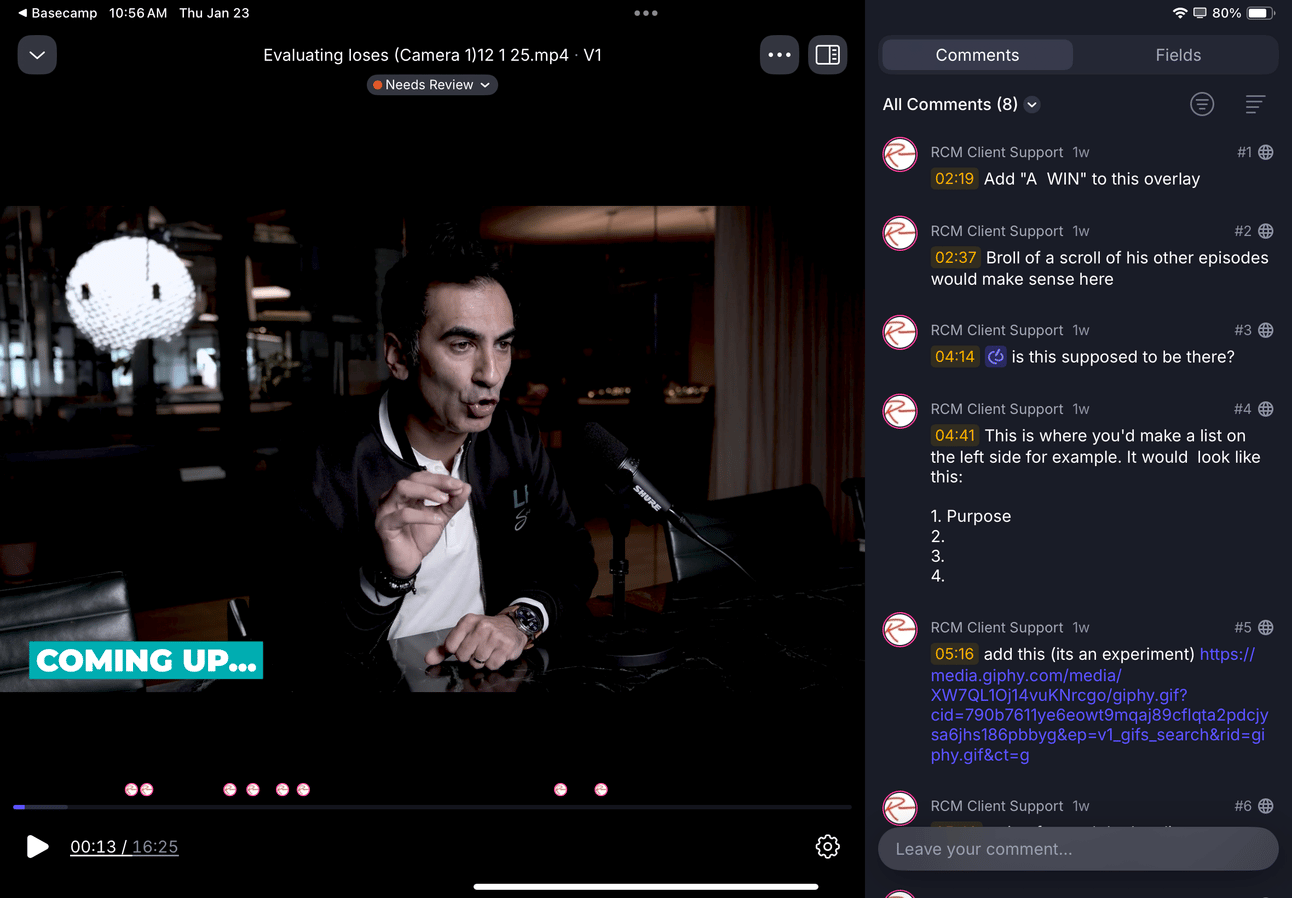
Frame.io
When all are approved, ensure they are labeled with Title and “Final”. (E.G. The 2025 Podcast Landscape Final) and stored in Google Drive.
Download and copy these files to your SSD. If you don’t want to take up so much storage you can delete all the raw files from the SSD and Google Drive. I recommend doing that only after the respective episode is published.
Stage the audio on your podcast host platform (upload audio, fill in title, show notes, etc) We use Captivate.fm Pro Tip: Make sure time stamps have parentheses around them for clickability in Spotify.
Stage the video into YouTube via YouTube Studio and use the same time stamps in audio to act as Chapters for YouTube . They should be fairly close.
Schedule the trailer to be released the week before the launch date which is when you’ll release 2-3 episodes.
Content You Should See
Sorry everyone, downloads are not the most important metric to your podcast.

Thanks for reading UNFLTR today - I’ll see you again next week!
— Rich

A snow day here in Wilmington, NC. My girls and their friends had a blast!
P.S. Ways to work with me:
1:1 Coaching
Monthly Consulting
Podcast Management (Ranges from audio only to Audio, Short Form, YouTube)
Interested? Reach out to [email protected]